
Wednesday, March 16, 2011

Saturday, March 12, 2011
International Colouring Chart
127 hours, Danny Boyle (2010)

The free-climber Aron Ralston (James Franco), is stuck in a narrow canyon in Utah, with his arm crushed abscission by a boulder from the rock. The days go by, the water begins to run low and Ralston remembers friends, lovers (Clémence Poésy), the family and the two hikers (Amber Tamblyn and Kate Mara) just before encountered in the course of five long, grueling days, fighting against the elements and his own demons, until you discover that you have the courage and the will to break free at any cost ...


The free-climber Aron Ralston (James Franco), is stuck in a narrow canyon in Utah, with his arm crushed abscission by a boulder from the rock. The days go by, the water begins to run low and Ralston remembers friends, lovers (Clémence Poésy), the family and the two hikers (Amber Tamblyn and Kate Mara) just before encountered in the course of five long, grueling days, fighting against the elements and his own demons, until you discover that you have the courage and the will to break free at any cost ...
After testing memorable as "Trainspotting" (1996), " 28 days after" (2002), "The Millionaire " (2008), and others a little less shining, Danny Boyle has given us this movie intense, dramatic, but who can be simultaneously cool, hectic, life. This is a true story to the free-climber Aron Ralston, who was a prisoner of mother nature and her strength and unrelenting Darwinian, in a fault in the rocky mountains of Utah. Given the synopsis, one would expect to see something extremely claustrophobic style "Buried" (2010) or something similar, but the inventive at times deliberately naive Boyle is able to combine lightness and heaviness of the story of many dramatic sequences, in a way that can be defined only as superfine. From an extremely dynamic and crackling soundtrack as much as the brilliant use of multiple shots from inside and subjective items such as straws, water bottles and glasses, Boyle takes us briskly with views to the same dynamic camera movements through wide and open, with a use of dolly spectacular. Boyle has certainly helped locations from which nature alone gratify the eye, but you know which is the eye of the director to make the shot artistically valuable. In this film just happens that the "reality" of locations, as well as the "true story" told, are represented by the British director with great creative skill. In fact, the film is never boring , even for a minute, even when we follow Aron caught between the rocks with his arm crushed by a stone while trying in vain to break free during the dramatic days that follow. That Aron is a real struggle for survival in which the "uncanny" is in the representation of loneliness and helplessness man in the face of Nature. It is interesting to Boyle's insistence in describing the total dependence of Aron (and anyone, of course) from their physiological needs: thirst, hunger, intolerance of physical pain. It seems here that the director would like to reflect on the theme of "limit" as the defining aspect of human identity, reflection, however, carried no easy horrorofili pessimistic, just to enchant or attract a certain type of audience. That is a reflection on Boyle's disturbing, painful mystery of things that permeates the world, a mystery "natural" to which we must look with optimism and vitality, because life is still all we have, and not cheap, golly. For lovers of adrenaline in sauce gore, the film does not disappoint, however, even on this front: the latest anatomical and bloody sequences are certainly not for delicate stomachs, but in any case always well balanced with the rest of script. Finally, a necessary note of praise to James Franco who plays the hapless Aron, struggling with a traumatic experience but will make him learn to distinguish between "vitalism" and "vitality", to understand that life is beautiful, but can also be dangerous, because you can die. "127 hours": highly recommended. DIRECTION: Danny Boyle SCREENPLAY: Danny Boyle , Simon Beaufoy Cast: James Franco, Kate Mara , Amber Tamblyn , Treat Williams , Sean Bott , Koleman Stinger , John Lawrence , Kate Burton , Bailee Michelle Johnson , Parker Hadley , Clémence Poésy , Fenton Quinn , Lizzy Caplan , Pieter Jan Brugge , Rebecca Olson PHOTOGRAPHY: Enrique Chediak , Anthony Dod Mantle ASSEMBLY: Jon Harris MUSIC: AR Rahman NATION: UK, USA PRODUCTION: Cloud Eight Films, Pathé GENRE: Biography, Drama, Adventure LENGTH: 94 Min
Wednesday, March 9, 2011

Monday, March 7, 2011
Polyester Running Pants
The Black Swan (Black Swan) by Darren Aronofsky (2010) Young


Nina ( Natalie Portman) is an ambitious young dancer in New York chasing a dream that all dual role: the White Swan, gentle and innocent, and the Black Swan, which gives off a seductive evil in the classic "Swan Lake", in can turn an unknown into a star. Nina manages to get the role, but is not sure she could embody the dark side of the Swan Queen. While reaching new heights with his body, nightmares, visions, hallucinations and visual coenesthetic, as well as destructive jealousy, began to emerge in a profound way, leading to a dangerous confrontation with a provocative new arrival, Lily (Mila Kunis), which represents its larger rival. Nina quickly goes down too well in the role of the evil and deadly Black Swan ...
"The Black Swan" is a film geometry, haunting and haunting in staging giustappunto mental and physical obsession, which then tends to become real in his psychosis outcome tragic in its final equally obsessively, geometrically "perfect". Natalie Portman plays a young dancer tends anorexic (like many dancers, unfortunately, actually), who lives with a mother who has cultivated the ideal of a perfect daughter as reflected in the narcissistic and make the broken dreams of his youth is now over. Aronofsky ("The Wrestler", 2008) unfolds the story of Nina Representing the element immediately clinical psychopathology, fishing without fear in the uncanny and gore, but so far, grain of salt, we could say , which is the best way to metaphorize psychic suffering devastating devouring a beautiful young woman. In this sense, are remarkably unsettling for the viewer of the sudden, completely unexpected sequences of harming the girl, especially those in which Nina is self-inflicted cuts fingernails, scarification or deep in the back. The relationship with her mother ill, and the ensuing pathology Nina, however, told by Aronofsky without the slightest hint of morbidity, but rather with great pietas, which is by far the best value of a film, however, difficult, very dark and tragic, I think especially in the eyes of a young female audience that will surely (and rightly) to run it. I would say that we have been waiting years had such a burst of pride on the part of American cinema, after decades of remakes and bubble bath in style Vidal Michael Bay and company. Aronofsky it prepares a work that will certainly remember, but above all a work miles away from the post-modern atmosphere that we are now accustomed to seeing a movie, and especially in the cinema so-called "uncanny." In an age of tissue and femininity seen as cannon fodder, here the director allows us to Brooklyn (vivaddio!) a profound reflection on psychology and psychopathology of women, considered by the Summit of the ideal of perfectionism and narcissistic, fingerprints harmful , but certain features of contemporary consumer culture-media. The film is in fact one hundred sociological or psychoanalytic treatment on "feminine" and "ego ideal" as a form of psychotic experience the theme of "success." On an aesthetic level, "The Black Swan" is also exemplary, both as regards the use of certain asymmetries narrative, always well calibrated in the course of the story, both with respect to any use of the absolutely masterful climax (the last sequences of mental and physical transformations of Nina, accompanied by a soundtrack perfectly fitting, are memorable, to that effect) and compared to the horror toning to the wise ( powerful and beautiful from this point of view the scene where the mother's drawings hung in the living room come alive, in one of the last of Nina hallucinations). "The Black Swan": films to see and be carefully investigated in the years to come, and that makes finding a shred of hope in contemporary American cinema.
Directed by: Darren Aronofsky Screenwriter: Mark Heyman, John McLaughlin Photography: Matthew Libatique Editor: Andrew Weisblum Music: Clint Mansell Performers: Natalie Portman, Mila Kunis, Vincent Cassel, Winona Ryder, Sebastian Stan, Barbara Hershey, Janet Montgomery, Toby Hemingway, Kristina Anapau Country: USA Production: Fox Searchlight Pictures, Protozoa Pictures, Phoenix Pictures Year: 2010 Duration : 108 min
Saturday, March 5, 2011
How To Make A Draught Excluder
uncomfortable


After some hesitation I finally decided to publish the cover of my book on contemporary youth distress, just out to Publisher Foschi types of Forlì. Here you can find further details on the next text, as well as a brief presentation comes from the back cover, clicking on the photo-link to the right, which we refer to the publisher's site. If anyone wants to read it, I will of course be pleased to know of opinions, criticisms and opinions of all kinds, in this regard. This is an essay, of course, but informative and written in a language not too psicanalese "although psychoanalysis is of course its theoretical horizon of reference. The book speaks of cinema but also, and (unbelievable but true) horror film, seen as generally very popular with teenagers (and always live by the adolescent in all of us "adults"). So I think might be of interest a large enough audience of readers, that is not only to psychologists, psychotherapists, teachers and educators.
Wednesday, March 2, 2011
Acrostic For Edward Cullen
Rubber, Quentin Dupieux (2010)

The vision of "Rubber", by Quentin Dupieux, I brought back to mind the famous surrealist painting by Rene Magritte in which we see a pipe, and just below the word paradox: "This is not a pipe" ("Ceci n'est pas une pipe"). In fact, "Rubber" is not a movie, but a reflection, at the edge of the philosophical, the film genre. To carry out this type of operation we might call, ending a bit overused, "Metafilm" Dupieux uses precisely register surreal classically understood (the surrealism of a Duchamp, for instance), staging an old, worn tires, providing own life and transforming it into a serial killer. But it's surreal narrative mode to rise to true star the film, not the tire itself, let alone the cast, and even the script in its central part, quite ordinary and intentionally derivative. Since the first Dupieux sequences (which here is also director of photography, as well as writer, as well as creator of the soundtrack) discovers cards immediately, place in a desert town in which they agreed some viewers equipped with telescopic sight. Here comes a car trunk from which emerges a local police officer (Stephen Spinella), holding a glass of water, which is aimed directly at the spectators, but also those on the set, explaining that the stories we tell to cinema, things happen "without reason: "Why in the Steven Spielberg film ET the alien is brown? No reason . Because in 'Love Story' the two main characters fall in love? No reason. "" Every great film, without exception, continues the cop-contains an important element in foolishness, because life itself is full of nonsense. "That said, the officer shall pay for the land content of the glass, dates in the trunk and the car starts again. Here begins the "story", which indeed has already begun, a "story" as seen through the telescopes of the spectators who are camping in the desert. Through this collective we viewers subjectively "real" we see the development of the story of an inanimate object that comes alive, rolls to the town and vibrating one of his mysterious paranormal powers, is able to blow the heads of humans at a distance. Everything is of course no reason, from the first sequence to the last. The problem with a film like this lies in its aesthetic procedure, ie nell'autoannullarsi as a cinematographic work, reducing the imaginary plane of a species of photography, painting, surrealistic painting of, dis-identifying with himself back into an sort of destructive fury that eliminates all the entertainment. It 's like if we went to the theater and the actors get off the stage to tell the audience: "Look, this is all fake, so do not believe it, because we do not believe either of us. So think about it, or get up and go away. "Some pioneering a miracle. Personally, I found the original of this Dupieux, simply because it is better suited to other arts, painting, for example, as the painting of Magritte, but he did not need to write a non-film Rubber like to tell us what we wanted to say with his pipe. "Rubber" to see if driven by strong curiosity or interest in philosophical existentialist and nothing more. ; Director: Quentin Dupieux Screenplay: Quentin Dupieux Photography: Quentin Dupieux Editor: Quentin Dupieux Music: Quentin Dupieux, Gaspard Augé, Sébastien Akchote Cast: Thomas F. Duffy, Stephen Spinella, David Bowe, Roxane Mesquida, Wings Hauser, Jack Plotnick, Haley Ramm, Courtenay Taylor, Blake Robbins, Remy Thorne, Devin Brochu, Ethan Cohn Country: France Production: Realitism, Elle Driver, Arte France Cinéma Year: 2010 Length: 85 min .

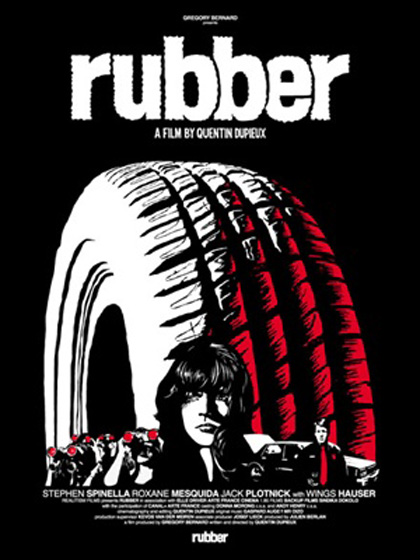
abandoned in an old tire middle of the desert comes to life, possessed by inexplicable and powerful powers, sowing death and destruction in the world around him ...
The vision of "Rubber", by Quentin Dupieux, I brought back to mind the famous surrealist painting by Rene Magritte in which we see a pipe, and just below the word paradox: "This is not a pipe" ("Ceci n'est pas une pipe"). In fact, "Rubber" is not a movie, but a reflection, at the edge of the philosophical, the film genre. To carry out this type of operation we might call, ending a bit overused, "Metafilm" Dupieux uses precisely register surreal classically understood (the surrealism of a Duchamp, for instance), staging an old, worn tires, providing own life and transforming it into a serial killer. But it's surreal narrative mode to rise to true star the film, not the tire itself, let alone the cast, and even the script in its central part, quite ordinary and intentionally derivative. Since the first Dupieux sequences (which here is also director of photography, as well as writer, as well as creator of the soundtrack) discovers cards immediately, place in a desert town in which they agreed some viewers equipped with telescopic sight. Here comes a car trunk from which emerges a local police officer (Stephen Spinella), holding a glass of water, which is aimed directly at the spectators, but also those on the set, explaining that the stories we tell to cinema, things happen "without reason: "Why in the Steven Spielberg film ET the alien is brown? No reason . Because in 'Love Story' the two main characters fall in love? No reason. "" Every great film, without exception, continues the cop-contains an important element in foolishness, because life itself is full of nonsense. "That said, the officer shall pay for the land content of the glass, dates in the trunk and the car starts again. Here begins the "story", which indeed has already begun, a "story" as seen through the telescopes of the spectators who are camping in the desert. Through this collective we viewers subjectively "real" we see the development of the story of an inanimate object that comes alive, rolls to the town and vibrating one of his mysterious paranormal powers, is able to blow the heads of humans at a distance. Everything is of course no reason, from the first sequence to the last. The problem with a film like this lies in its aesthetic procedure, ie nell'autoannullarsi as a cinematographic work, reducing the imaginary plane of a species of photography, painting, surrealistic painting of, dis-identifying with himself back into an sort of destructive fury that eliminates all the entertainment. It 's like if we went to the theater and the actors get off the stage to tell the audience: "Look, this is all fake, so do not believe it, because we do not believe either of us. So think about it, or get up and go away. "Some pioneering a miracle. Personally, I found the original of this Dupieux, simply because it is better suited to other arts, painting, for example, as the painting of Magritte, but he did not need to write a non-film Rubber like to tell us what we wanted to say with his pipe. "Rubber" to see if driven by strong curiosity or interest in philosophical existentialist and nothing more. ; Director: Quentin Dupieux Screenplay: Quentin Dupieux Photography: Quentin Dupieux Editor: Quentin Dupieux Music: Quentin Dupieux, Gaspard Augé, Sébastien Akchote Cast: Thomas F. Duffy, Stephen Spinella, David Bowe, Roxane Mesquida, Wings Hauser, Jack Plotnick, Haley Ramm, Courtenay Taylor, Blake Robbins, Remy Thorne, Devin Brochu, Ethan Cohn Country: France Production: Realitism, Elle Driver, Arte France Cinéma Year: 2010 Length: 85 min .
Sunday, February 27, 2011
Pokemon Emblem Gpsphone Cheats
Rubber (2010): trailer
I propose an extended trailer of "Rubber", new and eagerly awaited film by French director Quentin Dupieux. The trailer is interesting and indeed very "Beckett." We'll see, then, as the film.

I propose an extended trailer of "Rubber", new and eagerly awaited film by French director Quentin Dupieux. The trailer is interesting and indeed very "Beckett." We'll see, then, as the film.
Wednesday, February 23, 2011
What Can I Write In A Guest Book
Monsters, Gareth Edwards (2010)


Six years before the events recounted in the film, a NASA spacecraft returning from a space mission, crashed in Mexican territory with its load of alien life forms. In the days following the impact appeared in those areas new forms of life in the form of phosphorescent mushrooms, half of Mexican territory was quarantined and given the infected area. today in those areas will continue to fight with the military and Mexican Americans who are struggling to contain "creatures." In this scenario, post-apocalyptic war, an American journalist (Andrew) decides to accompany a tourist (Samantha), daughter of his publisher, traumatized by the fighting with the aliens across the border with the U.S. . Their trip to the Central American jungle, however, many surprises in store for them ...
"Monsters" 's English Gareth Edwards, starts badly and ends worse, we might say, while trying to immerse the viewer in an improbable sci-fi-horror wrote with his feet and carried out in an even more pedestrian. Incidentally, to give the floodgates to the list of mourners note that you will read here, that the "monsters" that boasts the film, in the grandiloquent title of the head, are nothing more than caricatures very childish of what 'we have already seen (but much better represented) elsewhere. This is because of large polyps crossed by blacks unnecessary phosphorescent streaks, of which we see a tentacle to escape from a lake in the dark, nothing less than an hour of film. In truth, Edwards had shown us an alien at the beginning of the film, but in a lopsided and shots that ape " Cloverfield" (2008) in an almost childlike. After this initial transient appearance, set in the quarantine zone and a war between Mexico and the United States, Edwards is not interested all the monsters of the title, as well as the spectators, concentrating on the figures of the reporter and his editor's daughter (two off Whitney Able and Scoot McNairy), dispersed in the Central American jungle in search of an escape route which took them to their "home sweet home" in the U.S.. The screenplay is groping in the dark as actors, especially in the middle, all centered in the boring, two-story building that can not take the ferry to the United States, forcing them to go into the forest, as in "Jurassic Park " (1993). We can then extend the usual pitiful veil of silence on the dialogue between Andrew and Samantha: dialogues absolutely sterile, diluted up to exasperation, winking to erotic-emotional developments that never come to fruition, a kind of delayed ejaculatio not interested in that no one except the director and his crew. The only interesting element of the long-and-so to speak, and adventurous journey of the two inexperienced players fantozziani, appears to be the natural scenery that reconstructs very well the environment just a natural disaster that hit the film's locations. In fact, there often seems to see a documentary about the devastating effects of Hurricane Katrina, more a film that somehow disturbing. The film 'at a glance awfully presumptuous about his desire to rework the theme of "extraterrestrial monster" without having any capacity,' it 'narrative, it' in terms of pure entertainment, or ad hoc use of 'special effect (even for its own sake, for heaven's sake), that does not and will not be 'in no time the film: when you have a budget risicatissimo as in the case of Edwards, must administer pecuniary in a balanced way, but equally effective, as did for example in Toby Wilkins' Splinter "(2008) . Here we are instead a thousand miles away from certain products or even low-budget indie able to innovate and impress because of their ability 'inventive released by base money. "Monsters" quagmire film that loots good ideas of others without producing anything good. To avoid. Director: Gareth Edwards Screenplay: Gareth Edwards Photography: Gareth Edwards Editor: Colin Goudie Music: Jon Hopkins Cast: Whitney Able, Scoot McNairy Country: Britain Production: Vertigo Films Year: 2010 Duration: 94 min.
Monday, February 21, 2011

Grey S Anatomy Season 7 Episode 7
DATE RAPE
I have no information on this project, so for now, I pecked their EP which is also free. Here
.
This, however, you feel immediately.
Cold Remains by DATE RAPE 
I have no information on this project, so for now, I pecked their EP which is also free. Here
.
This, however, you feel immediately.
Cold Remains by DATE RAPE
Sunday, February 20, 2011
International Colouring Chart For Hairdressing
Reflections of a debut author


It has a certain effect receive an email from your editor in which you say that your book is at the printers and will be distributed in early March. A publisher "true", then, that not one of those "pay", but I even paid the copyright (a pittance, but I was published and I will give several copies free). The "reflections" mentioned in the title, is about more than some other questions that arose in my mind, to talk about this relatively new to my blog readers: to speak of his book which is being published, it means, willy-nilly, to advertise themselves and to own publishing, which does not seem respectful, in fact, who passes through here in the sense that it exploits the attention and trust to talk about "narcissistic" of his goods, and (worse than to go at night) encourage readers to buy. Another story is that of someone who writes and publishes for free on their own, put it online (in e-book, for example) their works. Commendable (I did too, and found here e-books for free. It 's a test of psychoanalytic psychology, a little boring perhaps, but it can affect - especially those who make the teacher , for example). But now it is a different thing: a book "Real" paper, available in bookstores, which costs € 16, and consists of 272 pages. It has an ISBN, a foreword by a distinguished colleague, index, back cover, and a brief presentation of the author. As you can see my shyness means that does not reveal anything yet, neither the title nor the subject (although I had already talked a little bit in the comments, some time ago), or the publisher. I just wanted to share with those who read these tentative thoughts about "being published", and reflect on the meaning and opportunities to talk about such existential transformations-publishing a blog. For example, do not even know yet if I will speak of the book when it comes out. Or if I will post the cover. Or if I am happy that some of my friends will want to review the web on his blog. Boh. Let's see what happens. Meanwhile I wanted to open a small debate here. And then you tell me what you think (if you like).
Friday, February 18, 2011
Medical Marijuana Tendonitis
You and I, of Niccolo Ammaniti (2010)


Year: 2010 Publisher: Einaudi - Necklace "Freestyle Big" Pages: 121
ISBN: 9788806206802 Euro: 10.00
I decided to report the latest book by Niccolò Ammaniti, because I think in the panorama of contemporary Italian literature and this author has a talent and imaginative narrative of rare intensity. The writing of "You and I" is indeed fresh, airy, able to get us into the soul of a boy of fifteen years and make us feel the lightness of the thought of a teenager, why I happened to read a novel. An unbearable lightness of course, as the kunderiana "lightness of being." "You and I" is in fact a book which, a first, fleeting glance, it looks like a timid little thing from high school and complexity. This happens until the penultimate page and then the narrator will unleash a sudden blow its last pages, the content is obviously not revealed. The last page becomes the most important book in that very deep throws light on everything that is narrated above, closing the span of a prose that takes effect, so revelatory. Freud would say, probably, that we are facing the so-called literary expression Nachtreglichkeit , ie the "post-understanding" of the facts and experiences that happen to us, and that this is a feature essential part of our mind. "You and I" sounds like a hymn to the time-of-Life, its tragic, continuous creation and dissolution through countless moments of Nachtreglichkeit. remarkable is the fact that Ammaniti choose their own adolescence, when deconstruction of identity formation, to talk about this phenomenon is inherent in how we all perceive our lived time. And the author is very well able to make it through the "time telling" the "lived time" of a fifteen to grips with his twisted appear in adulthood. The effect of the last page, however, is really alienating (to almost uncanny, especially since entering family ties within an inscrutable dark and deep that borders with the theme of "disease"). "You and I", in short, is a novel that should be adopted as a required text in high schools across Italy, a 'Italy and the threshold of its 150 years, has completely lost any kind of sensitivity to the minors (and minors) , that is precisely in regard to what constitutes a glimpse into the future, as the chronicles political force us to see, unfortunately, every day. Be read to reflect on today and tomorrow.
Monday, February 14, 2011
Bosch Sgv56ao3 Dishwasher Faults
The Loved Ones, Sean Byrne (2009)


"The Loved Ones ', Australian Sean Byrne, is a small masterpiece that you have, and now, recommend to the lovers of' unheimlich film. On this line, I fully agree with the review of Elvezio Sciallis , which in turn invites everyone to rush to see it, but I find myself in some considerations written by Eddy , which is more severe with the film. To be more clear: "The Loved Ones" is not a masterpiece ( In fact, I spoke of "small masterpiece"), especially because of the script suffers from some holes that could be avoided (such as Brent-Xavier ago Samuel neutralize in two minutes, the thugs lobotomized in the hatch of the living room? What is Superman?). However, these "holes" pass in a flash in the background, in front of a delicious narrative pattern, which takes you by the collar and pulls you back from the first film until the last minute. I think this almost hypnotic effect of the film is essentially based on the performance of the protagonist, Lola, played by Robin McLeavy excellent, great crowds, and whose smile makes Durbans the chilling rise immediately to "princess" of my personal heroines of Olympus horror. Lola is a real killer hyena, which makes shoes for any Freddy Kruger that we can think of, and the father-daughter pair staged by Sean Byrne is a very rare appearance in the original horror movie scene today. I dare say that some sequences have learned even Fellini, like the one where Lola walked with her pink dress and a knife in hand, through the fields, while in the background stand out tall towers and blurred by the brilliant pop-art photography by Simon Chapman . Lola is a kind of perverse and degenerate Juliet of the Spirits, wonderful in his gait destructive alien as an alien determined to destroy the human race. Even his counterpart Brent, perfect choice by the director, to represent the typical high school player and traumatized (In a car accident caused the death of his father), though even here the script wobbling a bit, in my opinion, at all costs in wanting the black color of the trauma a story that he felt the need at all. On the whole, however, "The Loved Ones" depicts a sadistic gore-oriented movie extremely well, rhythmically punctuated by sudden swings and twists that are startling, and also played very well by the three main actors on the scene. E 'hoped that after this remarkable, original, tasty test, this director was born in Hobart, Tasmania, continues to develop his poetry as well. And if not disappoint us in our expectation, I think, based on "The Loved Ones," Byrne in the future there will see some good. Film to be seen without delay. Director: Sean Byrne Screenplay: Sean Byrne Photography: Simon Chapman Editor: Andy Canny Cast: Xavier Samuel, Robin McLeavy, Jessica McNamee, Richard Wilson, Victoria Thain, John Brumpton, Fred Whitlock Country: Australia Production: Ambience Entertainment, Madman Entertainment Year: 2009 Duration: 84 min.
Saturday, February 12, 2011
Rappers Wear Hats To Beef
The Rite of Mikael Hafstrom (2011)


Michael Kovak, a young seminarian American who is studying to become a priest, is in the midst of a crisis of religious faith. Tormented by a thousand doubts, finds her opportunity to find and demonstrate their faith when the Vatican is responsible for following an alleged case of demon possession ...
I confess that I approached to "The Rite" with some reluctance, as this fashionable insistence on the subject of demons and exorcism is largely coming to my boredom. Not enough "Devil" (2010), "The Last Exorcismus" (2010) and most recently "Exorcismus: The Possession of Emma Evans" (2010) to flesh out a subgenre which alone is not he had so much need to be fed. Perhaps in the wake of this latest fashion, all to investigate, all to explain, here is the Swedish director Mikael Hafstrom, after touring the interesting "1408" (2007), throws himself into his demonic and means to do so. Despite the reluctance, but since Hafstrom came from a good product just as artistic and perturbing "1408", I tried to listen to him. What I have heard, however, did not make me some miracle, let alone think that I came across something particularly innovative, compared to the sub-genre as such. Throughout the vision, the question essential that the head was spinning were as follows: just hop aboard the ship as a gauge of ninety Anthony Hopkins to create a memorable story, do not say as "The Silence of the Lambs," and even as "The Exorcist" but a certain weight? At the end of the vision the answer to that question was a strong, dry "NO". Beyond Hopkins, not even the handsome Colin O'Donoghue, dressed as Michael Kovak, the young seminarian, he convinced me, stuck in a script so enveloped dry, which forces it to fly by States to the Vatican, as if nothing had happened. The credibility of the entire system narrative approaches Manzoni probable, but it touches only tangentially, and on rare occasions. And this is a serious flaw of the screenplay, in my humble opinion. But I think what makes the intention of sinking completely Hafstrom in an original way to rework the theme of "possession," both want to insert in today's globalized context, for example those of the training course in the Vatican with the archive of possessed and the various technological supports staged inside a conference room that looks like the glossy lobby of Parliament, are sequences that simply destroy any demonic or similar pathos. Comes soon, ie, the nostalgia of the lean-to Regan, and especially of priests and powerful personality as carved in stone, like that of Father Karras (Jason Miller) and Father Merrin (Max Von Sydow). Hopkins is good, nothing to say, to be produced here as a bridge between us mere mortals and the Devil, but it absorbs, we might say, all the light of the film, to the detriment of the whole cast, but particularly the story itself, which does not inject significant shivering in the veins of the viewer (some old nail vomited by a young woman, is so disturbing, now?). The sequences of the rite of exorcism, are also the grotesque caricatures of those de "The Exorcist". In short, this "The Rite," reflects the shadow too derivative of the prototype of the mythological origins: Linda Blair seems to look sideways at the camera for Hafstrom, making grimaces, and making the whole thing almost pathetic. In terms of pure aesthetics, the film certainly does look: very good lights, music, makeup, special effects, the performances of the cast. However, the film remains outstanding between outstanding debts with "The Exorcist" Friedkin's, and the objective difficulty to give an emotion that emphasize its specificity compared to the model. "The Rite" to see only philological reasons, but without great enthusiasm.
Director: Mikael Hafstrom Screenwriter: Michael Petroni , Matt Baglio Photography: Ben Davis Editor: David Rosenbloom Music : Matt Baglio Cast: Anthony Hopkins , Colin O'Donoghue, Alice Braga, Ciarán Hinds, Toby Jones, Maria Grazia Cucinotta, Rutger Hauer, Chris Marquette, Franco Nero, Martin Gastini, Ben Cheetham, Nico Toffoli, Arianna Veronesi, Rosa Pianeta Country: USA Production: New Line Cinema, Contrafilm, Fletcher & Company Year: 2011 Length: 114 min .
Saturday, February 5, 2011
Thick Cm Before Period
I spit on your grave (remake, unrated), Steven R. Monroe (2010)

Jennifer, a beautiful young writer, is raped and tortured by a group of peasants in the his country house in the woods of Louisiana. Luckily saved by jumping into an icy river, and it is given up for dead.
survive and return to visit his assailants of seeking revenge ...
This "I Spit On Your Grave" by SR Monroe, a remake of the film Meir Zarco (1978, known in Italy under the title "Not raped Jennifer"), you shows how happy novelty in the film disturbing. The sub-genre referred to is of course that of rape-and-revenge, in which Monroe is yet able to inject heavy doses of gore . Doses of horse, we might say, especially the last half hour of film, from the As the theme of "revenge" is not treated with sottogliezza philosophical. From this point of view of the Monroe film pays homage to the original respectfully, in turn very violent for having been shot in the 70s. The novelty of this remake is in the limestone hand, deliberately, on the cruelty of revenge of a female writer, a figure that is intellectual, humiliated and tortured by a bunch of villagers American inhabitants of the province. We witness that is, a cruel woman, and what we might call postfemminista, to which the viewer is immediately brought to cheer, the male characters are odious, in any capacity they are declined (Think of the figure of the sheriff, a person really disgusting and absolutely isomorphic to the role of the gang of attackers). "I spit on your grave" is a raw film, direct, very visceral, yet shot with care and attention to detail, both visual and narrative. The violent psychological dynamic that characterizes the relationship between victim and perpetrator in the first part of the film, is also represented with great subtlety and emotional realism, enough to remember the spirit of Darwinian a Sam Pekimpah. There is indeed very interesting in this regard, the large movements machine alternating shots at ground level close-ups skewed. Sociopathy perverse phallic-group of males is also characterized by a considerable anthropological attention, as time has not been seen in a film of this type: the sequence of gang rape in the woods, for example, is painfully disturbing and beyond much, in terms of poetic disturbing, others remake of rape-and-revenge film, as For example, the craven "The Last House on the Left" (2009). The human cruelty against a woman, but in general of a helpless victim in the rape sequence, is made even sharper by the presence of Metafilm digital video camera that uses one of the pack during the scenes of torture. But we have not talked about the female lead, Sarah Butler, which is a particular acclaim for the intensity of an interpretation of which will not be easy to forget. Jennifer-Sarah Butler that rises to the mythic figure of vengeance Amazon, unconscious as a counter-female abuse of male power blind, ambiguous and traumatogeno. The trauma-death Jennifer fact determines its rebirth as a powerful figure and transfigured-castrating against male power. The screenplay (by the same director) underlines the transfiguring very precisely this: we see then, gradually, the transformation of a nerdy writer and intellectual, in hunter who frequents the woods where she was, driven first as a victim. The chief merit of the script and the film is in fact made in the intense and tragic narrative of this deadly toning, which transports us from oppression by relentless passion to revenge as a result. In this film by Monroe (as in that of Zarco) because there is no room for forgiveness, that Monroe seems to want to tell us that we live in an age and culturally regressed so anomic, to bring up the Biblical law of retaliation as a corollary of normal existence. Exceeded the threshold of the "law of retaliation", the logic of revenge and then invades the whole open field as water seeps into every crack, with no border, produces hatred and hatred is therefore proliferate. Use of gore latter part of the film therefore has the clear function to emphasize this character proliferative exponential characteristic of hatred as a passion human. E it is a gore rather sharp and brutal, much more than some ideas now commonplace for some well-known chapter of "Saw" (think Only the sequence of the suspension the bathtub in which Jennifer dissolve caustic soda, or that of the ravens that feed on the bloodied face of one of the rapists). A gore that displaces somewhat, especially because it comes after many sequences relatively relaxing. "I spit on your grave", this dense and tetragon remake of the legendary film Zarco, deserves, therefore, without doubt, all our attention. Director: Steven R. Monroe Screenplay: Steven R. Monroe Photography: Neil Lisk Music: Corey A. Jackson Performers: Sarah Butler, Chad Lindberg, Daniel Franzese, Rodney Eastman, Jeff Branson, Andrew Howard Country: USA Year: 2010
Friday, February 4, 2011
Why Does My Rabbit Run Round In Circles
Tentation de Saint Antoine (Grünewald) (about 1510-1516)


click to increase the size
few days ago I came back in my hands a small reproduction of this masterpiece of horror art, which is the "Tentation de Saint Antoine" (Altarpiece of Issenheim, Musée d'Unterlinden - Colmar) of Gothart Nithart Mathis, better known as Matthias Grünewald , painter of Wurzburg, Germany , active between late 1400 and early 1500. I find it very disturbing, and then you submit it.
Listen then as the critic HA Schmid described the poetics of painting of our own, by the early '900 "
| " A Grünewald not affect the expression and movement. The rule, the measure, the proportions of the human figure (which Dürer pursued throughout life) certainly have not affected much. its physical forms are mostly ugly, sickly, impossible or at least out of the ordinary, even when you do not sacrifice anything to the expression. The faces are asymmetrical, are found in almost every painting arbitrary design that have a justification Art, or omit the model, as is the case in the sketches. Already this fact, and arbitrary aspect ratio, show that the artist has been left upset by what is abnormal " | |
( HA Schmid, Die Gemälde und Zeichnungen von Matthias Grünewald, 1911 )  | |
Wednesday, February 2, 2011
Average Catering Cost 150 People
Altitude of Kaare Andrews (2010) Vanishing

Director: Kaare Andrews Screenplay : Paul A. Birkett Photography : Norm Li Assembly : Chris Bizzocchi Music : Jeff Tymoschuk Cast : Jessica Lowndes, Julianna Guill, Ryan Donowho, Landon Liboiron, Mike Dopud, Jake Weary, Ryan Grantham, Chelah Horsdal, Michelle Harrison Nazione : Canada, USA Produzione: Anchor Bay , Escape Factory, Foundation Features, Thin Air Productions Year : 2010 Duration: 90 min.


Addie is a beautiful eighteen year old fresh air of his pilot's license. He lost his mother in a terrible plane crash ten years earlier and her father has forbidden to board any airplane flying, let alone drive it. But the girl's desire to fly over its problems is so great, so, in defiance of a ban on paternal , decided to bring four of his friends (Cory, Ming, and Bruce Sal) at a rock concert with a twin-engine bell'otto places. The flight begins, but a faulty altimeter and an approaching storm forces Addie to get into a huge bank of fog that seems endless. And in that fog seems to be something monstrous that awaits them. ..
In spite of the poster that I think the most interesting and evocative film disturbing in recent years, "Altitude" unfolds before the eyes of the viewer in so leaden plaster, minute after minute of film. After about half an hour's vision is to wonder what exactly you're looking at, given that the screenplay scatters clues that guide the supernatural from the early sequences, through references that recall the atmosphere of a good old "Creepshow" (1982), exhumed for the occasion by a director, however, the author of comics various Typically, as evidenced by his resume. The "supernatural" actually arrives, but only in the last quarter of an hour for the rest of a film narrative petrified in a twin engine in perennial failure unlikely. Andrews insists on close-ups of the protagonists, made faces as the metal fuselage of the plane from tourism through the use of a frozen stock (Norm Li) to remove the little pathos assets. This insistence becomes clearly a pitiful screen behind which the director thinks he can hide the absolute inconsistency of a story that does not involve or scared at all. The use of close-ups insisted it is an aesthetic device which can become very powerful when used by skillful hands, such as those of Adam Green in "Frozen" (2010). Here it only serves to underline what has melted mascara glamorous Jessica Lowndes (Sara, the protagonist and the pilot of the aircraft), during one of his improbable crying. Dialogues and interactions between the five teenagers trapped in the cursed twin engine, are simply laughable, especially because of the presumption would seem realistic. But it is the screenplay by Paul A. Birkett, to produce a disaster of proportions anaudite, which shows itself in our eyes sequence after sequence (which is also expected after the previous evidence of a writer very poor: see the unwatchable "Escape Velocity" - 1998 and " With Express "- 2002). We say simply that Birkett is capable of canning pure boredom in a plane flying between Canada and the United States, and then pretend to put a scare monster amphibious pseudolovecraftiano on a cloud in the sky ; thinking maybe to be reversed because the original appearance and setting of "20,000 Leagues Under the Sea ", moving upwards. Birkett, however, is not Jules Verne, and we need someone to tell them as soon as possible, otherwise, without realizing it, one day finds himself locked in an asylum. For its part, Andrews, after this mess (even the soundtrack can be viewed separately from the image) would be much better to return to his comic book, a field in which will certainly do better. Film review simply to report and to indicate to carefully avoid the vision
Director: Kaare Andrews Screenplay : Paul A. Birkett Photography : Norm Li Assembly : Chris Bizzocchi Music : Jeff Tymoschuk Cast : Jessica Lowndes, Julianna Guill, Ryan Donowho, Landon Liboiron, Mike Dopud, Jake Weary, Ryan Grantham, Chelah Horsdal, Michelle Harrison Nazione : Canada, USA Produzione: Anchor Bay , Escape Factory, Foundation Features, Thin Air Productions Year : 2010 Duration: 90 min.
Friday, January 28, 2011
Fairweather Dresses 2010 Ottawa
on 7th Street, Brad Anderson (2010)


When a massive blackout plunged the city of Detroit in total darkness, a diverse group individuals take refuge in a bar. The population of the whole city has disappeared into thin air, leaving behind piles of empty clothes, cars left to themselves and threatening clouds that stretch mysteriously on the walls of the city. Soon the light of day begins to disappear completely, and the survivors, they realize that darkness hides sinister and murderous entity, and that only the desperate search for alternative sources of light can lead them to salvation.
We expected a lot from this "Vanishing on 7th Street", especially given the substantial filmography that behind him, which stand out in interesting films like " Session 9 "(2001), "The Machinist" (2004), "Transsiberian" (2008). It therefore seems almost inexplicable that an absolute decline of inspiration by a director who has proved far more able to handle the tension within well-constructed and original screenplays. The skilled directorial hand at times such as we see Hitchcock in "The Machinist", by which we are trapped in an early sequence, it switches off and fades away, simply "Vanishes", as suggested by the title. In the face of a subject rather intriguing that deliberately wants to revisit an issue somewhere between the apocalyptic horror (the disappearance of humanity at the hands of ill-defined entity "dark" who live in the shadows) the outcome of the film writing a script so full of potential, but is reduced to a reflection pseudosociologica of very little weight, reduced to a theatrical performance in a closed room (the bar "Sonny's" where the survivors took refuge). After a start that bodes well, enlightened by the excellent photo Uta Briesewitz, the film goes completely lost orientation and wrap it so convoluted and senseless end to a very unconvincing, but in line with altr'onde conduction and disorganized hebephrenic that Anderson gives the whole film. It does not help the cast, which sees a Thandie Newton unnecessarily hysterical and over the top especially in the early sequences, and above all Hayden Christensen parchment and unreliable since the sequence of its awakening in the skyscraper empty of human life (and only surviving only because, listen, listen, "saved" by two candles burning at his bedside during the night of the black out). Very good Jacob Latimore, James, the boy, whose performances are lost, however, very early in the foggy mists of a very little incisive film from any angle you look at it. Not to mention the suspense, non-existent, as well as dell'effettistica, trivial, which is merely to make us see long shadows (threatening? Come, no joking) who gather every so often on the walls of Detroit. It seems almost certain sequences of review of any "Boogyman" certainly did not want us to evoke a film of Anderson. "Vanishing on 7th Street" is a big hole in the water caused perhaps by a moment of grave crisis in art by a talented director, but in this case loses its compass showing they could not handle the matter nor narrative, neither the actors nor the setting, nor the technical equipment that would be available. Film definitely not recommended, although reluctantly. Director: Brad Anderson Screenplay: Anthony Jaswinski Photography: Uta Briesewitz Editor: Jeffrey Wolf Music: ; Lucas Vidal Cast: Hayden Christensen, John Leguizamo, Thandie Newton, Taylor Groothuis, Jacob Latimore, PJ Edwards Country: USA Production : Magnet, Errick Entertainment, Mandalay Vision Year: 2010 Length: 91 min .
Sunday, January 23, 2011
Pregnant, Held A Baby With Meningitis
Take me somewhere nice, of Pearry R. Teo (2004)


After becoming a professional photographer, Jared decides he wants to see his son that he never knew because the father decided to leave home when their son Jamie, who is now 8 years, was born. During their first meetings, it is clear that the years of separation makes their relationship very difficult and distant. But when Jamie begins to take a liking to her father's camera, creative and emotionally a new relationship begins. "Take Me Somewhere Nice" is the story of a father of a child and how love is a feeling very fragile to be kept alive, in a complex and chaotic world.
"Take me somewhere nice" is a short drama. Teo Pearry with us here to explore new paths of its visioning film, of all paths other than the two previous experiments horror, but on which dominates once again the issue of lost loved object. In the case of this short, this is the "loss of relationship, the bond between father and son. " Take me somewhere nice "is a film about the absolute and irreversible precariousness of the human condition, its fate depend on a unpredictable, and for this very dramatic. We could say that if the courts above, the villain was a specific character (the demon that takes possession of Julian in "Libera Me", and the Guardian of Purgatory, in "Children of the Arcana), and in this short Teo 2004, villain is the destination itself, which meet again eight years after a father and a son, a young man who works as a photographer, and a child of just eight years, then, causes a terrible accident, tear them apart again, and this time, definitely. "Take me somewhere nice" is a film that leaves no way to a relatively pessimistic view of the topic dell'irraggiungibilità object of love. It 's a film Heidegger, as it seems to want to tell us that our being-there in life is a being-there for Death. Teo is able to film all this density of interaction relationships, philosophy and drama of pathos, with a light hand, ie not be in a hurry to define boundaries, concepts, and categories. At times this film has a rather even the lightness of "The Amélie" Jean-Pierre Jeunet, 2001, even in bright pastel colors of photography (great stuff) by David E. Valdez. It 'just that moving light on issues such as heavy family drama of the breaking of blood ties and affection, the true, great strength of this film, plus the honor of being a short script built on a clean and without' use of dialogue. If we add further capacity, by Teo, to express his poetic experimenting with different genres, as well as the courage to confront the issue of pain without pretense holliwoodiane or hypocrisy, then "Take me somewhere nice" becomes really a little gem definitely worth mentioning to those who have a keen eye to the evolution of the creative mind of an artist, especially a director. "Take me somewhere nice" : short of remarkable artistic, philosophical knowledge. Director: Pearry R. Teo Screenplay: Pearry R. Teo Photography: David E. Valdez Special Effects and Make Up: Michael Peterson Sound Designer: Lisa Fowle Cast: Braxton Cole, Clint James, Shanna Brock, Frances Feld, Brian Mulligan, Jennifer Barry.Julia Altamirano. Country: USA Production: Ascension Pictures. Year: 2004 Length: 17 min .
Subscribe to:
Posts (Atom)